By Isaac Olushola Ogunkola – Global Fund Programme Manager | April 2026
In March 2025, with harm reduction services collapsing across the globe in the wake of the U.S. foreign aid freeze, INPUD launched a 12-day rapid assessment survey to capture what was happening on the ground. We heard from 101 organisations and networks across 45 countries – the vast majority community-led – about service closure, laid-off peer workers, and communities turning to underground networks for sterile needles and syringes they could no longer get from trusted providers.
That survey became the backbone of our April 2025 report, The Human Cost of Policy Shifts, which we presented at the Commission on Narcotic Drugs (CND) and shared with donors, governments, and UN agencies worldwide.
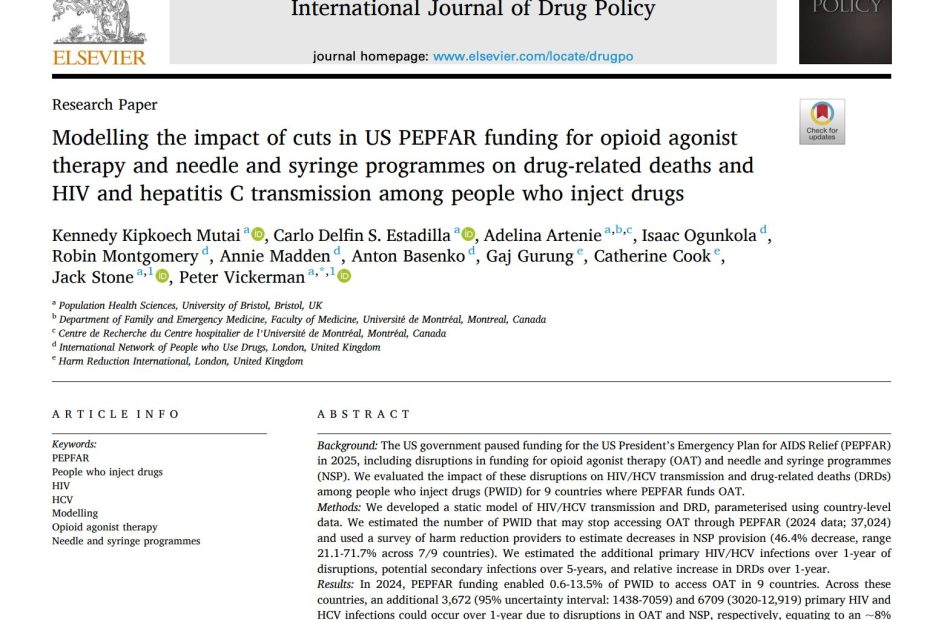
Now, that community-generated data has been taken further. A new peer-reviewed modelling study, published this week in the International Journal of Drug Policy, uses INPUD’s survey data to quantify, in numbers, what the PEPFAR funding cuts mean for HIV transmission, hepatitis C transmission, and drug-related deaths among people who inject drugs.
(primary + secondary, 5 years)
(primary + secondary, 5 years)
What the modelling found
Researchers at the University of Bristol, working in collaboration with INPUD and Harm Reduction International (HRI), built a mathematical model covering the nine countries where PEPFAR directly funded opioid agonist therapy (OAT): India, Kenya, Kyrgyzstan, Mozambique, South Africa, Tajikistan, Tanzania, Uganda, and Ukraine.
The findings are stark.
In 2024, PEPFAR funding enabled approximately 37,024 people who inject drugs to access OAT across these countries. PEPFAR provided 86% of all OAT in these settings and 100% of OAT in India, Tanzania, and Uganda. Meanwhile, INPUD’s survey data showed that nearly half of all NSP provision has been disrupted by the funding cuts, affecting an estimated 124,710 people.
Primary HIV Infections
Additional new HIV infections among PWID over 1 year of disruptions
Primary HCV Infections
Additional new hepatitis C infections among PWID over 1 year of disruptions
Secondary HIV Infections
Onward HIV transmissions from primary infections, projected over 5 years
Secondary HCV Infections
Onward HCV transmissions from primary infections, projected over 5 years
Over just one year of disruptions, the model projects an 8% increase in both HIV and HCV infections across all nine countries. In the seven countries where both OAT and NSP were disrupted, the increase jumps to 20% for HIV and 18% for HCV.
Drug-related deaths could increase by up to 8.5% in Kenya and 7.6% in Mozambique, where PEPFAR-funded OAT coverage was highest. Overall, across nine countries, the weighted increase in drug-related deaths is estimated at 1.4%.
NSP disruptions are driving most of the damage
What’s driving the increase?
Across most countries, disruptions to needle and syringe programmes not OAT alone account for 60–87% of the projected rise in new HIV and HCV infections. An estimated 124,710 PWID could lose access to NSP as a result of these disruptions.
This underscores something our community has long known – access to sterile injecting equipment is foundational to harm reduction. When access to NSP is disrupted, it negatively impacts many other areas of health and wellbeing for people who inject drugs.
Drug-related deaths by country
| Country | PEPFAR OAT Coverage | % Increase in Drug-Related Deaths |
|---|---|---|
| Kenya | 13.5% | 8.5% |
| Mozambique | 12.4% | 7.6% |
| Tanzania | 7.0% | 4.1% |
| Kyrgyzstan | 2.9% | 1.6% |
| Ukraine | 2.3% | 1.5% |
| Uganda | 2.1% | 1.1% |
| India | 1.6% | 0.8% |
| Tajikistan | 1.0% | 0.5% |
| South Africa | 0.6% | 0.4% |
| Overall (weighted) | 2.4% | 1.4% |
Community data made this possible
What makes this study distinctive is that it was built, in part, on evidence generated by our community. INPUD’s rapid assessment survey – designed, disseminated, and analysed by people who use drugs – provided the real-time data on NSP disruptions that directly parameterised the model. Without that frontline intelligence, the researchers would have had far less data to accurately model the impact of NSP cuts.
This is what meaningful community engagement in research looks like: not tokenistic consultation, but data that shapes the science.
The estimated cost to provide OAT and NSP to all individuals affected is a fraction of the long-term health costs of inaction.
What needs to happen now
The paper’s conclusions align with INPUD’s ongoing advocacy. Alternative funding mechanisms must be established urgently. National governments need to step in where the U.S. has stepped out. And international bodies – including the Global Fund – must prioritise emergency resource allocation to harm reduction for people who inject drugs.
These numbers are not abstractions. Behind every projected infection is a person – a peer worker who lost their job, a community member who can no longer access sterile needles, someone forced into unsupervised withdrawal because their OAT clinic closed. Our rapid assessment gave them a voice. This modelling study gives that voice the weight of published, peer-reviewed evidence.
Read the full open-access paper: Mutai KK, Estadilla CDS, Artenie A, Ogunkola I, Montgomery R, Madden A, Basenko A, Gurung G, Cook C, Stone J, Vickerman P. Modelling the impact of cuts in US PEPFAR funding for opioid agonist therapy and needle and syringe programmes on drug-related deaths and HIV and hepatitis C transmission among people who inject drugs. International Journal of Drug Policy. 2026;152:105290.
https://doi.org/10.1016/j.drugpo.2026.105290
Read INPUD’s original rapid assessment report: The Human Cost of Policy Shifts