Home » Global HepC Community Advisory Board (CAB)Global HepC Community Advisory Board (CAB)
Global HepC Community Advisory Board (CAB)
We are a 20+ member Global Community Advisory Board (CAB) providing governance oversight and on-going guidance on the design, implementation and evaluation of the novel 10-country, multi-year harm reduction research project funded by UNITAID to prevent hepatitis C among people who inject drugs in low- and middle-income country settings.
Background on the HCV Portfolio Project
The Hepatitis C Portfolio Projects (HCV Portfolio) comprise three UNITAID-funded, consortia-led, research projects. The aim of the three projects is to test the feasibility, acceptability and effectiveness of innovative harm reduction tools to prevent hepatitis C (HCV) among people who inject drugs (PWID) in ten low- and middle-income country settings. All ten countries integrate service delivery within harm reduction programming.
The HCV Portfolio aims to expand access to hepatitis C testing and treatment for people who inject drugs through simplified and decentralised models of care, and generate evidence that is critical to enabling the broader use of low dead space syringes and needles (LDSS/N) and long-acting depot buprenorphine (LADB). This includes understanding user values, preferences, addressing high market costs and promoting cost effectiveness models, increasing demand, and demonstrating effective delivery.
Our partner countries include:
– Egypt
– Nigeria
– Tanzania
– South Africa
– Armenia
– Georgia
– Kyrgyzstan
– Ukraine
– India
– Vietnam
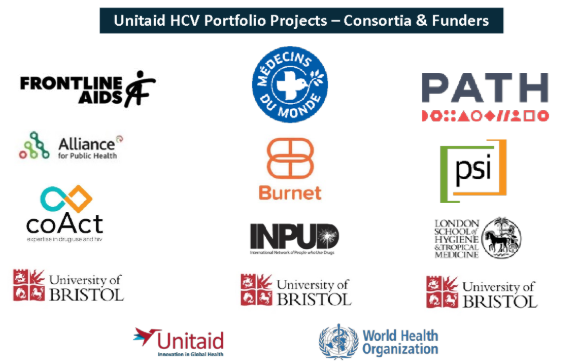
This critical work is led by the following international non-governmental organisations and their consortium partners:
Médecins du Monde: Catalyse uptake of Under-utilized Tools & Treatment Simplification for Hep C (CUTTS HepC)
– International Network of People who Use Drugs (INPUD)
– Burnet Institute
Frontline AIDS: Innovate, Involve, Inspire: Preventing Hepatitis C Through Community-Led Harm Reduction (HEPCIII)
– coAct
– Bristol University (UK)
– Alliance for Public Health (Ukraine)
PATH: HCV Combination Prevention in PWID and Prisoners Project (HEPC3P).
– Population Services International (PSI)
– London School of Hygiene and Tropical Medicine (LSHTM)
– Bristol University (UK)
The Global Community Advisory Board (CAB):
The International Network of People Who Use Drugs (INPUD) and CoACT Technical Support Limited are community-led technical experts to this 10-country, multi-year harm reduction program of research. INPUD, the global peer-based network of people who use drugs, supports people who use drugs to access and participate in international policy processes and to advocate for the health, rights and dignity of people who use drugs globally.
As the global network of people who use drugs, INPUD hosts the CAB Secretariat and INPUD’s Executive Director chairs the Global CAB; CoACT is a key technical partner and is Vice-Chair to the CAB.
The purpose of the HCV Portfolio Global CAB is to:
1. Contribute input, engagement, and participation to the ethical monitoring, implementation, and evaluation of the HCV Portfolio research projects.
2. Ensure that the lived/living experiences and feedback of people who use drugs (PWUD) inform the study.
Ensure that the work of the HCV Portfolio contributes to improved access to HCV prevention, diagnosis, treatment and care for all communities of people who use drugs.
To meet this purpose, the Global CAB works as an oversight committee and more directly with the respective project teams to:
– Advise on study design, protocols, enrolment, recruitment and community education to ensure community voices, concerns and impact are considered
– Act as ambassadors for the project by sharing information and progress among the regional- and country-community-led networks of people using drugs and the global community
Specific CAB roles and responsibilities include (but are not be limited to):
-Providing review and feedback on the Long-Acting Depot Buprenorphine (LADB) and Low Dead-Space Syringes/Needles (LDSS/N) research protocols, study design and research tools.
– Providing review and feedback on the Models of Care study, as needed and appropriate, given the intersections with the themes and delivery of the other two projects. CAB activities under the Models of Care study are conducted at country-level.
– Monitoring study implementation, recommending community-led monitoring approaches and providing advice on implementation challenges.
– Fostering community education, engagement, and knowledge exchange.
– Supporting community consultations, which includes seeking input and reflection from immediate team members as well as working with Consortia partners to carry out broader community engagement strategies and activities under the HCV Portfolio Projects.
– Recommending communication and information dissemination strategies.
– Ensuring efficient use of community-led technical support resources and avoiding duplication.
– Supporting and advising on demand generation.
– Acting as a focal point concerning risk management so country community-led partners have a clear route to share lessons, highlight concerns, troubleshoot, and identify effective strategies.
– Act as representatives to national or country-level steering committees to facilitate strong linkages and enhance community participation at the national/country level.
The fundamental principles underpinning the CAB’s work are cemented by the promotion and protection of human rights and equity for all people who use drugs in all aspects of the HCV Portfolio. Nothing for us, without us!
Why are CABs important to the health, rights, and dignity of people who use drugs worldwide?
The right to participation has long been recognized in international human rights law. The Principles for the Meaningful Involvement of Communities and Civil Society in global health governance are a best practice guide for all stakeholders in global health. They aim to ensure that the expertise and lived experience of communities and civil society is recognized and that their voices and power in decision-making processes is formalized to ensure more effective and representative governance structures and program/research design, implementation and evaluation at global, regional, and country levels.
Centering meaningful community involvement through community-led research and advocacy on the best approaches to harm reduction approaches to prevent and treat hepatitis C is a crucial step towards better and more equitable health access for people who use drugs, and is a critically important demonstration of how we put these principles into practice.
Please bookmark this page! This page is just getting started and will be updated on a regular basis with research updates, CAB publications, resources, event coverage and shared reflections and lessons learned. Not to be missed!!
CUTTS Hep C Project
Community-led LDSS/N Values & Preferences Research: Country Reports
These country reports share findings from community-led values and preferences research conducted by INPUD, the Burnet Institute and Médecins du Monde (MdM) on the introduction and scale-up of low dead space syringes and needles (LDSS/N) in Armenia, Georgia, and Tanzania as part of the Unitaid-funded CUTTS Hep C Project.
Led by community researchers, the research centres the knowledge, experiences and priorities of people who inject drugs in decisions about which LDSS/N products are introduced and how they are distributed. The reports explore not only preferences for different injecting equipment, but the wider realities that shape access and uptake, including injecting practices, equipment quality, service delivery, stigma, policing, and other structural barriers.
The reports will grow with the research. Phase 1 captures community values and preferences before the introduction of LDSS/N; Phase 2 follows participants as they pilot selected products; and Phase 3 examines the longer-term implementation and uptake and use of LDSS/N in real-world settings. As each phase is completed, an updated version of each country report will be published here and on the Burnet website, building a cumulative account of what communities want, what works in practice, and what is needed to support acceptable and sustained LDSS/N access.
Currently available: Phase 1 country reports for Armenia and Georgia, in English and Armenian and Georgian. Tanzania Phase 1 country report in English and Swahili will be available soon and subsequent phases will also be added as they become available.
Armenia | Phase 1 | English / Armenian
Georgia | Phase 1 | English / Georgian
Low Dead Space Needles & Syringes (LDSS/N) Advocacy Tool
LDSS Training for Community Researchers and Peer Educators
LDSS/N Focus Group Video
Script for LDSS/N Focus Group Video
LDSS/N Generic Poster
LDSS/N Generic Cards
LDSS/N Client Education Leaflet
LDSS/N Assessment Resource
Long-acting depot buprenorphine: an opportunity to expand choices for opioid agonist maintenance therapy and increase coverage of HIV and HCV prevention
What should I know about Long-Acting Depot Buprenorphine?
Client Guide to Opioid Agonist Maintenance Treatment and Long-Acting Depot Buprenorphine
Peer Education Tool: Long-Acting Depot Buprenorphine
Long-Acting Depot Buprenorphine – Client Literacy and Choice Course