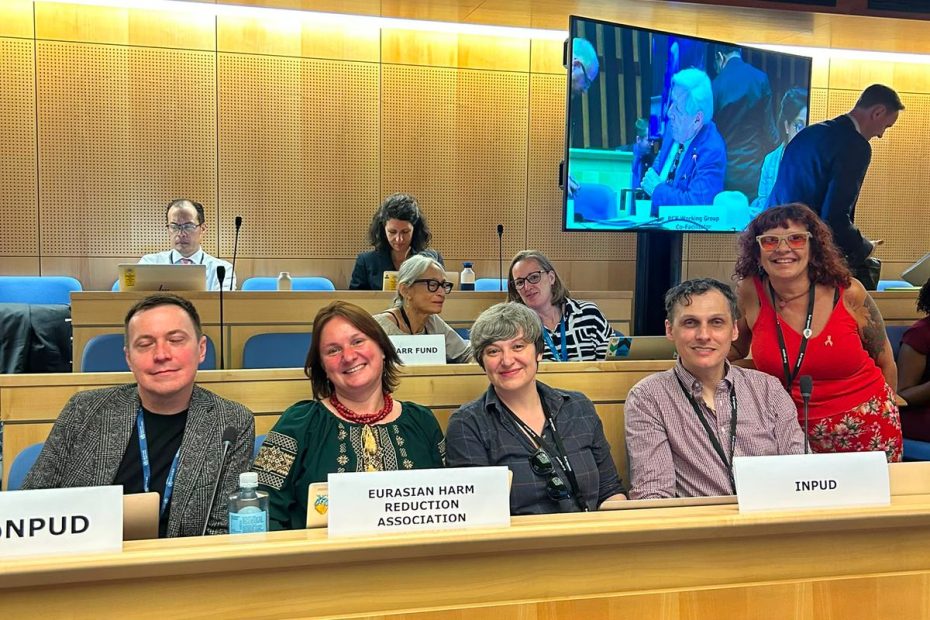
The 58th session of the UNAIDS Programme Control Board (PCB) took place 30 June – 2 July 2026 in Geneva, Switzerland. The PCB is the governing body of UNAIDS, bringing together Member States, UN Cosponsors, civil society and observers to discuss strategic priorities affecting the global HIV response. INPUD was one of many NGOs in attendance
On the first day of the PCB, INPUD’s Executive Director, Anton Basenko, gave the following intervention in response to the Report of the UNAIDS Executive Director:
Thank you Chair,
I am speaking on behalf of the International Network of People who Use Drugs, as a person living with HIV, and as someone with lived experience of drug use.
I thank the Executive Director for the report and particularly welcome its recognition that community leadership, human rights and equitable access to health services remain essential if we are to end AIDS.
But today I must also bring a warning from our community.
The HIV response is no longer facing only a funding crisis. It is becoming a crisis of survival for many people who use drugs.
INPUD’s new report, The Human Costs of Policy Change: A World in Turmoil, documents what happens when funding cuts collide with criminalisation and shrinking civic space.
We are witnessing needle and syringe programs closing or being severely reduced— a lack of access to harm reduction supplies spiked from 47% in 2025 to 64% in 2026, stigma and discrimination jumped from 60% to 77%, policing or criminalisation increased from 42% to 64%.
For women who use drugs, the consequences are even more severe, with reductions in gender-based violence services, child-friendly spaces and low-threshold treatment programs.
As someone who has lived through HIV, hepatitis C, criminalisation and exclusion from healthcare, I know that people do not stop using drugs because services disappear. They simply disappear from services—until they return with advanced HIV, tuberculosis, hepatitis C, or not return at all.
The lesson is clear: funding community-led harm reduction is not optional. It is one of the most cost-effective investments in the HIV response. We cannot end AIDS while allowing the organisations closest to affected communities to disappear.
INPUD therefore calls on Member States and donors to protect and expand sustainable, direct and flexible funding for community-led organisations of people who use drugs; to safeguard comprehensive harm reduction services, including needle and syringe programmes and opioid agonist therapy; and to accelerate drug policy reform, including decriminalisation, as an essential structural intervention for ending AIDS.
Our message is simple: if communities disappear, the HIV response disappears with them.
Thank you.
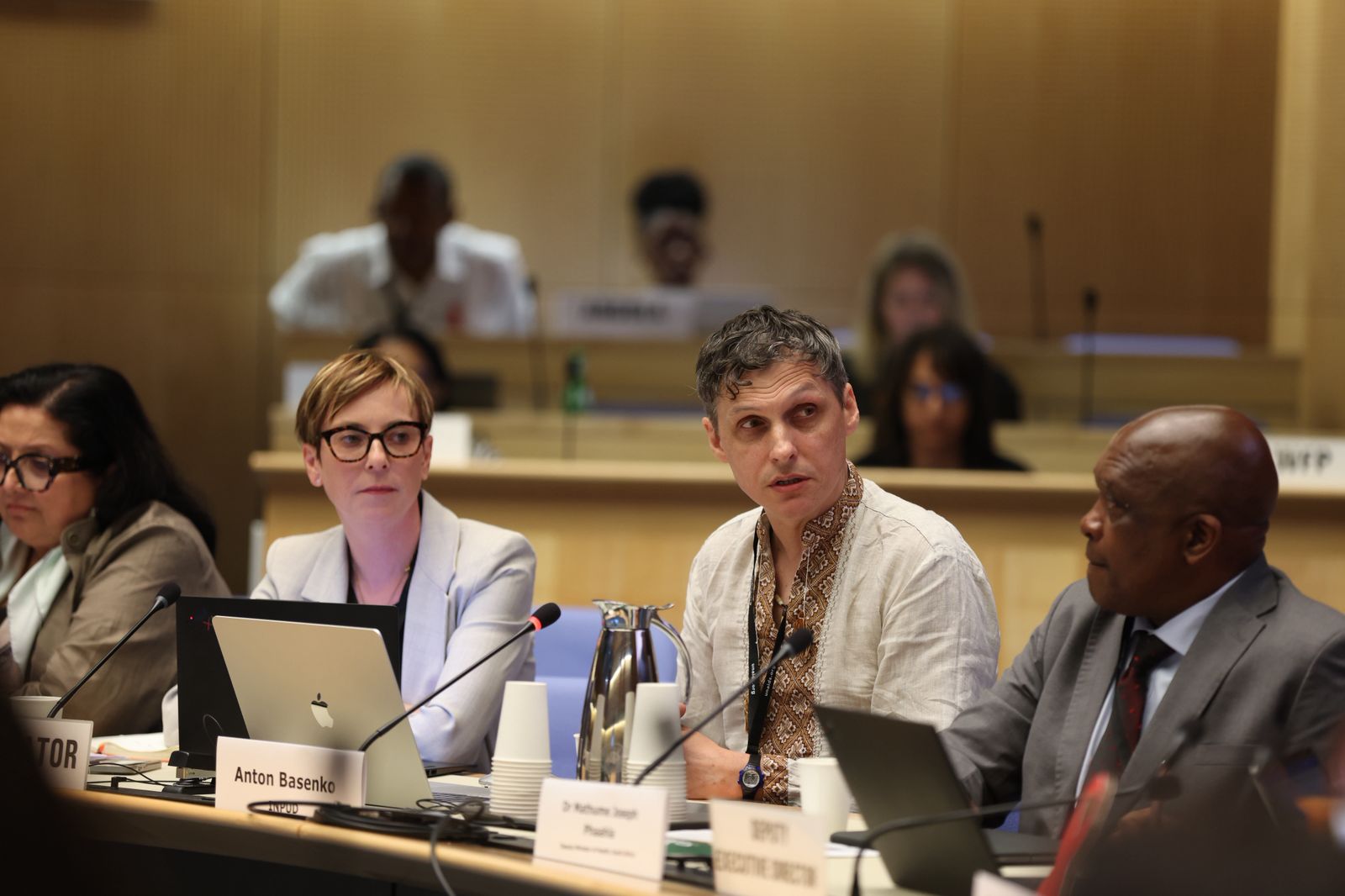
The final day of the PCB, 2 July 2026, was dedicated to the thematic segment: “Beyond 2025: Countering health inequities through sustaining the HIV response, human rights and harm reduction for people who use drugs.” This full-day event provided an opportunity to have a detailed, nuanced conversation on a programmatic area determined through a PCB Working Group, of which INPUD is a member. The focus of this thematic segment was discussing the implementation of the Global AIDS Strategy (2026-2031) by addressing structural barriers which continue to undermine progress for people who inject/use drugs. These barriers include criminalization, sustainable funding for community-led harm reduction programmes, and gender-based inequalities among others.
Anton Basenko again represented INPUD during the opening dialogue of the thematic sessions, speaking alongside the Executive Directors of UNAIDS and UNODC as well as the Deputy Minister of Health for South Africa. Read his statement below:
Chair, Executive Director, distinguished delegates, colleagues, friends, thank you for the opportunity to speak today.
When we discuss sustaining the HIV response beyond 2025, I am reminded that for many of us this conversation is not abstract. It is deeply personal.
I stand before you today as the Executive Director of the International Network of People who Use Drugs—INPUD—but first and foremost as a person who uses drugs, living with HIV, who is alive because harm reduction existed when I needed it most.
I began using drugs as a teenager and started injecting at sixteen. Like millions of people who use drugs around the world, I experienced the consequences of stigma, discrimination and punitive drug policies long before I experienced compassionate healthcare.
Everything changed when, at the age of twenty-three, I walked into a community-led needle and syringe programme in Kyiv.
I did not go because someone convinced me to seek treatment. I went because I simply needed sterile injecting equipment. But what I found was much more than syringes. I found peers who treated me with dignity instead of judgement. That was like a Miracle Number One.
Through that service I received my first HIV and hepatitis C test, learned my diagnosis, but was linked to HIV care while waiting for antiretroviral treatment. That was like a Miracle Number Two.
Later, through the same service, I became one of the first thirty people in Ukraine to access opioid agonist treatment (OAT). For the first time, I believed my future could be different. And that was like a Miracle Number Three.
Can you imagine – one community-led service completely changed the course of my life?! For people who use drugs, needle and syringe programmes are not simply HIV interventions. They are often our first trusted contact with healthcare. They are the bridge to HIV testing, treatment, hepatitis care, tuberculosis services, overdose prevention, OAT and social support. Most importantly, they are places where people are treated as human beings.
Very early in my journey, I also learned another lesson: continuity matters. In 2005, Ukraine was deciding whether OAT would continue after its pilot phase. Because of the gap between funding phases, one day we arrived at the clinic and found the doors closed. We were simply told: “We’ll call you when the programme starts again.” For me, it felt like the end of the world.
That experience pushed me into advocacy. I spoke at the Ministry of Health public hearings that ultimately helped secure continuation of the programme.
It taught me that policies are never abstract.
They determine whether people live or die.
Whether services remain open or disappear.
Whether communities are treated as partners—or as problems.
Today, more than twenty years later, that lesson is more relevant than ever.
Because continuity matters.
However, in many ways, this conversation feels deeply familiar.
More than a decade ago, many of us gathered in this very Programme Coordinating Board for a thematic discussion on HIV, people who use drugs and harm reduction. We spoke about stigma and discrimination. We spoke about criminalisation. We spoke about the need to expand harm reduction, invest in community-led responses and place human rights at the centre of the HIV response.
And we are grateful because those conversations led to commitments. They gave us hope and things have changed. But, yet today, I still cannot help but feel a sense of déjà vu.Too many of the recommendations we made then are the very same recommendations we are making today.The difference is that today we face an even more fragile environment.We cannot afford to be sitting in this room another ten years from now, repeating exactly the same conversation.
Because continuity matters.
When harm reduction disappears—even temporarily—the consequences are immediate But, this is exactly what our community is witnessing today. Over the past year, INPUD surveyed community-led organisations across the world. Our latest report, The Human Costs of Policy Change: A World in Turmoil, shows that the emergency is no longer simply financial.
It has become an emergency for the health, rights, dignity and lives of people who use drugs. Across countries, needle and syringe programmes are being reduced or closed. Outreach teams are disappearing. Overdose prevention is scaling back. Mobile services are ending. Community organisations—and in some places entire community movements—are struggling to survive.
This should concern every person in this room.
Needle and syringe programmes reduce HIV transmission by around fifty percent and hepatitis C transmission by more than seventy percent. But just as importantly, they connect people who would otherwise never enter healthcare. When these services disappear, people do not stop using drugs. They disappear from healthcare.
Our report also reveals another dangerous trend. Funding cuts are happening alongside increasingly punitive drug policies. Communities report increased police surveillance, raids, shrinking civic space and growing criminalisation. Together, these forces push people further underground and further away from HIV services.
At the same time, community-led organisations—the very organisations that have carried the HIV response for decades—are facing an existential crisis. Community leadership cannot survive on volunteerism alone. If we believe in community leadership, we must fund it through direct, flexible and predictable financing.
People who use drugs are not simply beneficiaries of HIV programmes.
We are first responders.
Peer workers.
Researchers.
Advocates.
Partners in strengthening health systems.
Community-led responses build trust, increase uptake of HIV prevention, treatment and care, improve health outcomes and save lives. They are among the smartest investments any health system can make. But none of this is possible if we disappear.
As we look beyond 2025, our choice is not between different policy options. It is between courage and complacency. Between keeping promises—or breaking them. Between saving lives—or accepting preventable deaths.
Today I spoke about three miracles that changed my life. But I have come to realise something.
Those were never miracles.
They were evidence-based interventions.
They were investments.
They were political decisions.
And because someone chose compassion over punishment, science over ideology, and humanity over stigma—I am standing before you today.
The question is simple:
How many more lives are waiting for those same decisions?
To the Member States gathered here today and worked with us over decades:
You have committed to ending AIDS.
You have committed to leaving no one behind.
You have committed to protecting human rights.
Now make those commitments real.
Fund harm reduction.
Protect community-led organisations.
End punitive laws that drive people away from healthcare.
Put people who use drugs where they belong—at the centre of the HIV response.
History will not judge us by the declarations we adopted. It will judge us by whether people who use drugs were still alive because of the decisions we made.
The time to act is now. Please stop making people depend on miracles.
Make them public policy.
Make them sustainable financing.
Make them human rights.
Make them reality.
So that, ten years from now, we are not gathered here once again repeating the same calls to action—but celebrating the lives we saved because we finally chose to act. Because every person who uses drugs deserves the same chance that I was given—not by luck, but by design.
Thank you.